Metal fabrication has always been a game of precision. A single measurement error, a missed tolerance, or a misread drawing can turn a straightforward job into a costly rework. That’s why more shops — including ours — are shifting toward model-based manufacturing (MBM), a workflow that replaces guesswork with data-driven, 3D-model-first production.
If you’ve ever wondered why some fabrication shops consistently deliver flawless parts on the first try while others struggle with fit-up issues and delays, the answer often comes down to this one shift in how work is planned and executed.
What Is Model-Based Manufacturing?
Traditional fabrication relies heavily on 2D drawings. A welder or fabricator looks at a flat blueprint, mentally translates it into a three-dimensional part, and then builds it by hand. That translation step — going from paper to metal — is where most errors creep in.
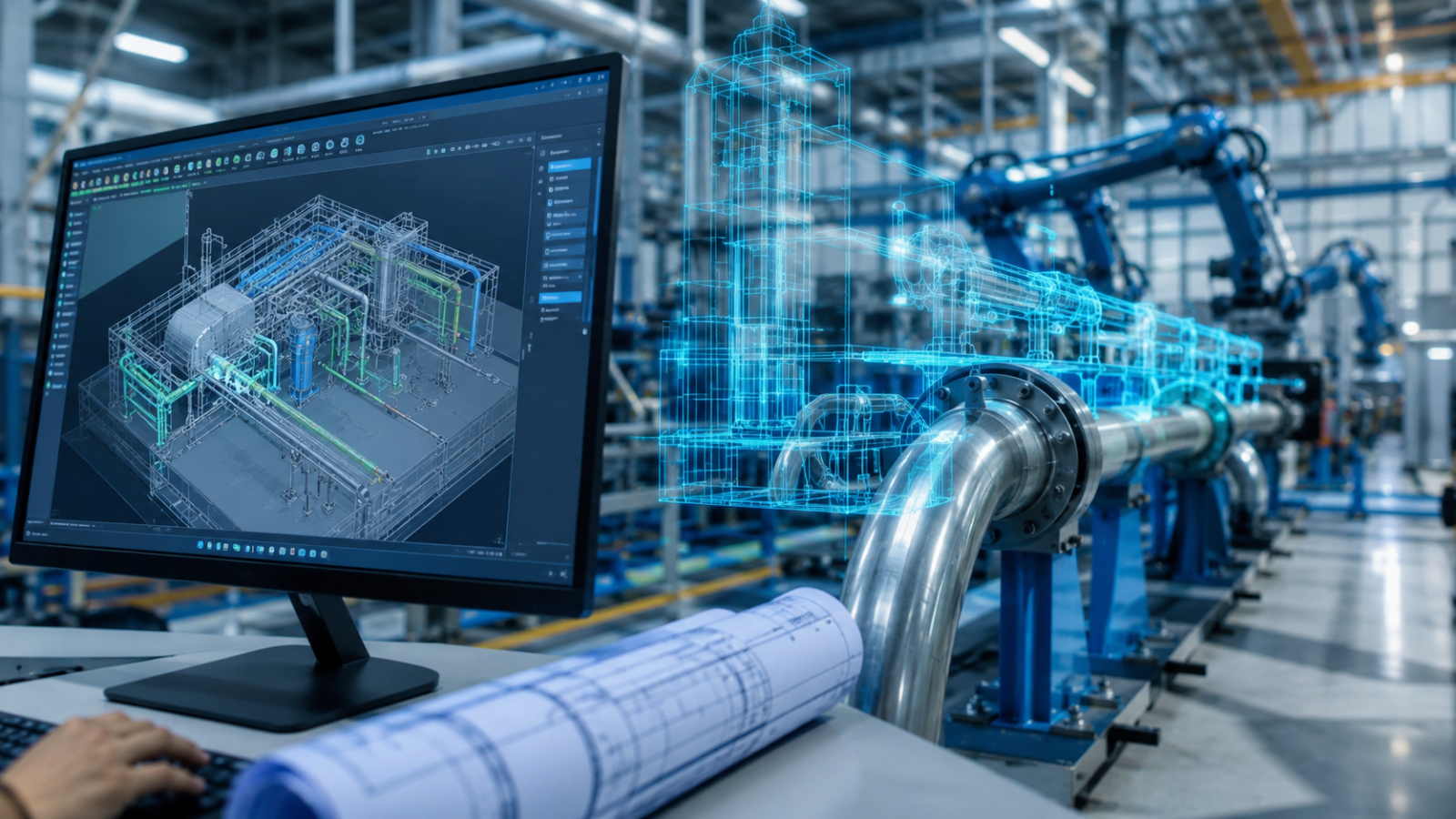
Model-based manufacturing removes that guesswork. Instead of working from static drawings, fabricators build directly from a detailed 3D digital model that contains every dimension, tolerance, weld symbol, and material specification embedded right into the design. The model becomes the single source of truth for the entire job, from cutting and bending to final assembly.
In short: everyone on the floor is literally looking at the same “truth,” not their own interpretation of a flat drawing.
Why Fabrication Errors Happen in the First Place
Before looking at how MBM helps, it’s worth understanding where errors typically originate:
- Misread dimensions — small numbers on a 2D print get transposed or misjudged
- Version confusion — a team works from an outdated drawing revision
- Communication gaps — engineering intent doesn’t fully translate to the shop floor
- Manual calculations — angles, offsets, and cut lists calculated by hand introduce rounding errors
- Assembly guesswork — parts that look fine on paper don’t always fit together in reality
Each of these issues compounds on complex jobs, especially in custom metal fabrication projects where dozens of parts must come together within tight tolerances.
How Model-Based Manufacturing Cuts Down on Mistakes
1. One Accurate Source of Information
Because the 3D model carries all the specifications, there’s no room for the kind of misinterpretation that happens when someone reads a flat drawing. Dimensions, weld locations, and material call-outs are baked directly into the model, so fabricators are working from exact data rather than an approximation.
2. Clash Detection Before Cutting Begins
One of the biggest advantages of model-based workflows is the ability to catch interference problems — where two parts would physically collide — before any metal is cut. This kind of virtual “dry fit” saves hours of rework and material waste that would otherwise show up during assembly.
3. Automated, Precise Cut Lists
Instead of manually calculating angles and lengths, model-based systems generate cut lists and nesting layouts automatically. This dramatically reduces human error in the math and makes better use of raw material, which also helps keep project costs predictable.
4. Better Communication Between Design and the Shop Floor
When engineers, project managers, and welders are all referencing the same digital model, there’s far less back-and-forth over what a drawing “really means.” This is especially valuable for projects that combine mechanical piping with structural steel, where multiple trades need to coordinate around the same space.
5. Traceability and Version Control
Every change to a model-based project is tracked. If a revision happens midway through a job, the entire team is automatically working from the updated version — eliminating the classic problem of someone building from an outdated print.
6. Fewer On-Site Surprises for Mobile and Field Work
For jobs that involve on-site fitting, having an accurate model ahead of time means fewer surprises when crews arrive. This is a major advantage for mobile welding projects, where field adjustments can be expensive and time-consuming.
Real-World Benefits for Clients
For business owners and project managers, these technical improvements translate into tangible advantages:
- Fewer delays caused by rework or part mismatches
- Lower material waste, since cut plans are optimized digitally
- More accurate quotes, because model-based takeoffs are more precise than manual estimates
- Faster turnaround, since less time is spent correcting avoidable mistakes
- Consistent quality, even across complex, multi-part assemblies
This approach pairs naturally with good ongoing maintenance and repair practices, since equipment and structures built with tighter tolerances tend to hold up better and require less corrective attention down the road.
Is Model-Based Manufacturing Right for Every Project?
Not every job needs the full weight of a model-based workflow. A simple bracket or a one-off repair may not justify building a detailed 3D model. But for larger or more complex work — multi-piece structural assemblies, process piping systems, or projects with tight architectural tolerances — the upfront investment in modeling pays for itself many times over by preventing costly errors later.
If you’re weighing whether your next project calls for this level of precision, it helps to understand the basics of how metal fabrication works and how custom welding services improve project quality overall — model-based manufacturing is simply the next step in that same pursuit of accuracy.
Frequently Asked Questions
Does model-based manufacturing cost more than traditional fabrication?
There can be a small upfront investment in modeling time, but it’s typically offset by reduced rework, less wasted material, and faster project completion.
Is model-based manufacturing only for large industrial jobs?
It offers the most value on complex or multi-part projects, but even mid-sized jobs benefit from more accurate cut lists and fewer fit-up issues.
How does this affect project timelines?
Because errors are caught before cutting or welding begins, projects tend to move faster overall, with fewer stoppages for corrections.
Can model-based methods be used alongside traditional 2D drawings?
Yes. Many shops use 2D drawings for client review and approvals while relying on the 3D model internally to guide actual production.
Does this improve quality for on-site or mobile welding work?
Absolutely. Having an accurate model ahead of time means field crews arrive with a clear picture of exactly how parts should fit, reducing costly on-site adjustments.
Final Thoughts
Model-based manufacturing represents a meaningful shift in how fabrication shops approach accuracy. By building from a single digital source of truth instead of relying on manual interpretation, shops can catch problems before they become expensive mistakes — saving time, material, and money for everyone involved.
Whether you’re planning a structural steel project, a piping system, or a custom fabrication job, working with a team that embraces precision-first methods can make the difference between a smooth build and a stressful one. If you’d like to discuss how these methods could apply to your next project, reach out to our team for a free quote.